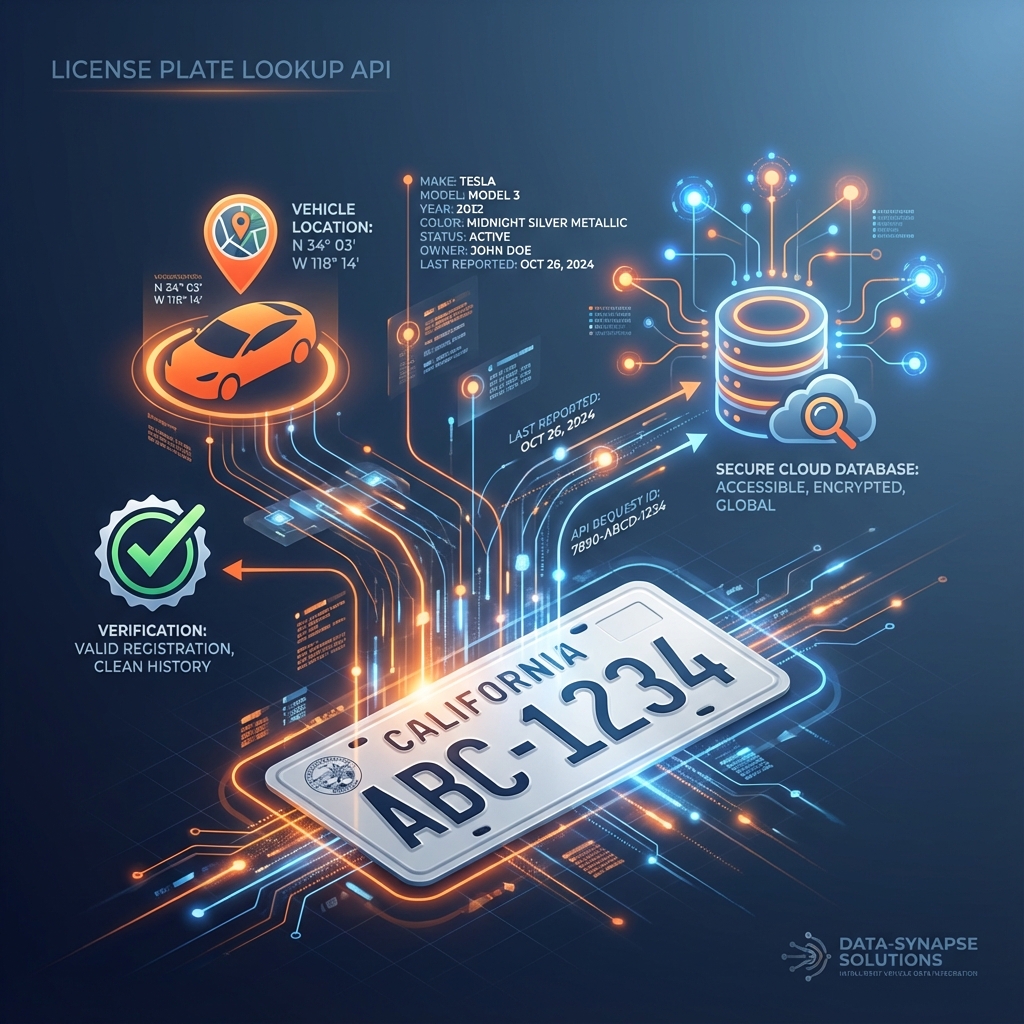
How License Plate Recognition Works
The license plate is the most visible identifier of a vehicle. Unlike a VIN, which is hidden behind a windshield or on a door jamb, the plate is designed to be seen. This makes it the primary data point for Smart City initiatives, tolling, and parking management.
However, a license plate number alone is just a string of characters. To be useful, it must be linked to the vehicle's identity. This is where our reverse license plate lookup technology comes in.
The Plate-to-VIN Conversion Process
When you send a request to our API with a plate number (e.g., "ABC1234") and a state (e.g., "CA"), we perform a real-time query against multiple DMV databases and private aggregators.
- Standardization: We normalize the input, removing special characters and correcting common OCR errors (e.g., confusing '0' with 'O').
- Lookup: We query our indexed database of over 200 million active registrations to find the associated Vehicle Identification Number (VIN).
- Enrichment: Once the VIN is identified, we append full vehicle specifications (Year, Make, Model, Trim) and current registration status.
The State of LPR Technology (ALPR vs. ANPR)
Automatic License Plate Recognition (ALPR), also known as ANPR (Automatic Number Plate Recognition) in Europe, has evolved significantly. Early systems relied on simple pattern matching and required expensive, dedicated hardware.
Today, our API leverages Deep Learning and Computer Vision to process images from standard IP cameras and even smartphones.
Cloud Processing
Best for mobile apps and occasional scans. Images are sent to our servers, processed by our massive GPU clusters, and results are returned in < 500ms.
Edge Processing
Best for high-speed tolling. The OCR happens directly on the camera hardware to minimize latency, and only the text string is sent to our API for data enrichment.
Handling State-Specific Nuances
US license plates are notoriously difficult to standardize. Unlike the EU's uniform format, every US state has its own designs, fonts, and stacking rules.
- Stacked Characters: Many states stack letters vertically (e.g., "T" over "R" for Truck). Our parser correctly linearizes these.
- Vanity Plates: We support custom backgrounds and symbols (hearts, stars) by filtering them out to isolate the alphanumeric registration code.
- Temporary Tags: We can decode paper temporary tags, which often use different fonts and layouts than permanent metal plates.
Integration Architecture
Integrating LPR into your workflow is straightforward. Here is the typical data flow for a parking garage application:
1. Camera captures image of vehicle entry.
2. Edge software extracts plate number ("ABC1234").
3. Backend server calls API: GET /v1/plate?plate=ABC1234&state=CA
4. API returns VIN, Make (Tesla), Model (Model Y).
5. System verifies if "Tesla Model Y" is authorized for entry.
6. Gate opens.
Compliance with DPPA Regulations
Access to license plate data is heavily regulated by the Driver's Privacy Protection Act (DPPA). This federal law protects the privacy of personal information assembled by State DMVs.
Our API is fully compliant. By default, we return non-PII (Personally Identifiable Information) data, such as the vehicle's make, model, and year. Access to restricted data (such as the owner's name and address) is strictly limited to authorized entities with a permissible use case, such as:
- Government agencies and law enforcement.
- Insurers and claims investigators.
- Licensed private investigators.
- Towing and impound companies.
Audit Trails & Data Retention
For DPPA-authorized users, we maintain strict audit trails of every query. You must log the "permissible use" reason for each lookup. We retain these logs for 5 years as required by federal law to protect against misuse.